
Offshore wind energy has become one of the key technologies driving Europe’s energy transition. However, operating this type of infrastructure requires advanced monitoring and control systems capable of ensuring asset availability, coordinating maintenance operations, and supporting continuous power generation in highly complex technical environments.
Within this context, the Saint-Brieuc offshore wind farm stands out as a landmark project developed by Iberdrola through its subsidiary Ailes Marines, off the coast of Brittany, France. Following projects such as West of Duddon Sands, Wikinger, and East Anglia One, Saint-Brieuc represents one of the company’s most significant milestones in offshore wind development and a major step forward in advancing Europe’s energy transition.
A Strategic Project in France
Saint-Brieuc is the first operational offshore wind farm in Brittany and one of the first large-scale offshore wind projects in operation in France. Its development represented an investment of nearly €2.4 billion and involved the collaboration of multidisciplinary teams and companies from several countries, strengthening the industrial value chain associated with offshore wind energy.
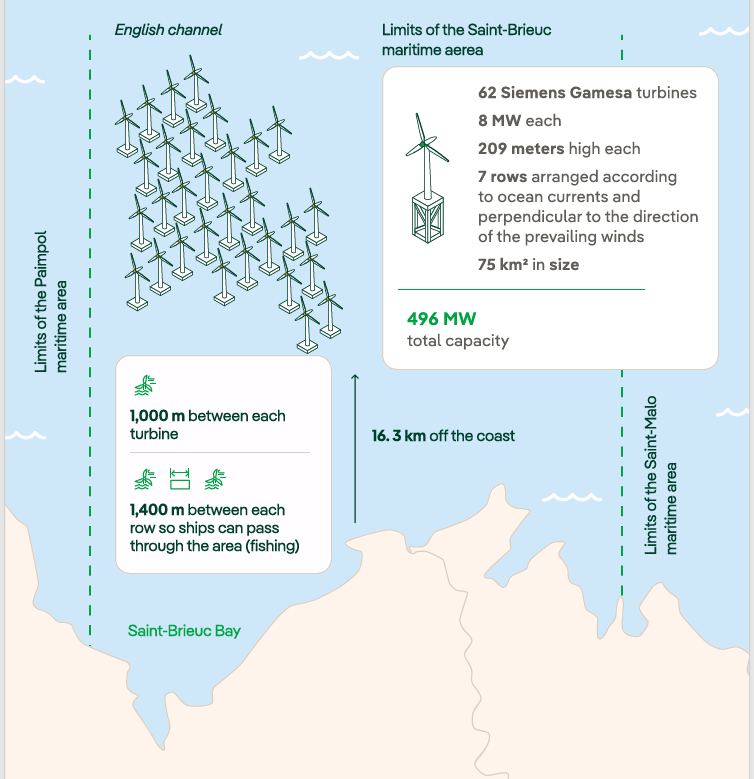
With an installed capacity of 496 MW, the facility consists of 62 next-generation offshore wind turbines, generating approximately 1,820 GWh of renewable electricity each year. This output is equivalent to the annual electricity consumption of more than 800,000 people, supplying approximately 9% of Brittany’s total electricity demand.
The wind farm is located 16 km off the coast of the Bay of Saint-Brieuc, with the generated electricity transmitted to shore through two 33.5 km submarine export cables.
Operating infrastructure of this scale requires a control center that is staffed 24 hours a day, 365 days a year, designed not only to monitor electricity generation but also to coordinate all wind farm maintenance activities, ensuring safe and continuous operation.
Following the successful experience gained on previous offshore wind projects, Iberdrola once again entrusted CT with the development of both the local SCADA system, located in Binic-Étables, and its integration with the remote control center in Whitelee, Scotland, from where the wind farm is operated.
The solution developed by CT enables real-time monitoring of more than 6,000 signals from both the electrical substation and the wind turbines, providing comprehensive visibility into the operational status of the facility and supporting informed decision-making from the remote control center.
The entire system was developed by CT Engineering Group’s teams, who also leveraged our own testing laboratory to validate the correct operation of all signals and communications before field deployment. This verification phase significantly reduced commissioning time during both port activities and offshore operations, minimizing project execution risks.